
Salesforce Communities Demystified
- 13
- September
- 2013
This summer, Salesforce unveiled their latest product – Communities – that boasts a new way of doing business. Communities replaces current Partner Portal and Customer Portal and puts great emphasis on building social engagement. Since its introduction, CM-Focus has been getting many queries about what Communities is and how a business can leverage it. In this article, I’d like to share with you our insights on Salesforce Communities and its customized usage for businesses.
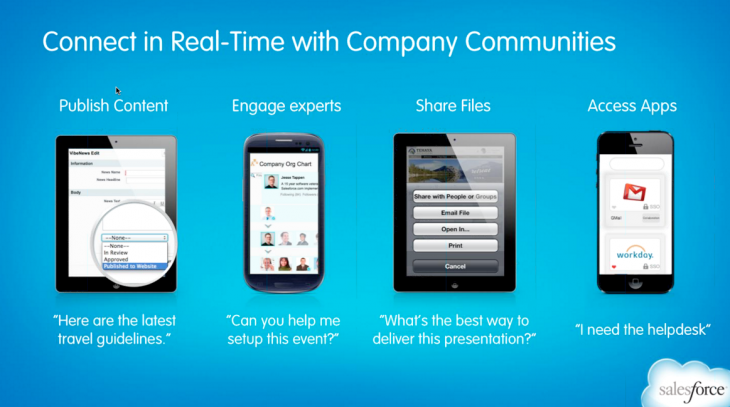
Salesforce Communities is Business Process + Social + CMS/Branding, all on ONE platform
While Portal takes care of the business processes in the office, Communities not only does that, but also takes you out of the office to meet your partners and customers. Since the online social networking explosion, businesses realize the need of engaging customers beyond the traditional buy-sell process to establish stronger brand and loyalty. Many choose social media such as Facebook and Twitter while some build customized solutions. No matter which method you choose, there is one big problem – the solution is disconnected from the rest of the business process. They are in disparate systems. They are costly to implement and maintain.
Salesforce Communities solves the problem by uniting your social and branding effort with the existing business process under one platform. It not only handles the business functions as in Portal, but also has the capability to engage customers and partners organically in a familiar setting like common social media. Your partners and customers can also participate in dialogues among themselves. At any time you find an engagement requires business action, Communities makes it easy to carry out because everything is on the same platform. One platform also gives you the advantage of customizing and maintaining consistent branding and experience throughout.
So what does this really mean to you and your business?
Rather than listing hypothetical scenarios that may or may not apply to you, I’d like to share with you a couple stories from CM-Focus’s clients.
One CM-Focus client offers service to connect investment banks with companies seeking funding. In the old days, the back office operations were manual and ad-hoc due to the lack of a centralized location for collaboration. To streamline the process, CM-Focus implemented Salesforce Communities and created a private network for premier investment banks focusing on lending to small and medium size companies. With Communities, the client now easily collaborates with investors on the latest funding deals and significantly increases the deal flow and execution.
Another client has benefited from Communities right at the start of the product cycle. Traditionally, finding out new product issues from the field is time consuming and difficult. CM-Focus helped simplifying the beta release process by implementing Communities for a selective group of partners and customers. The client’s Product Managers were able to discover field issues quickly through Chatter feeds and implement changes accordingly. Furthermore, customers in the Beta Program Communities were able to share best practices with one another. The client enjoyed more efficient product development and highly satisfied customers from this experience.
Customer and partner engagement is no longer a mantra. It can be done for your business. No matter you want to stay on with Portal or move to Salesforce Communities implementation, CM-Focus is here to help. Please feel free to contact us at info@cm-focus.com.



Recent Posts
- Account Based Marketing – How Is It Different, and What Are The Best Tactics?
- Add new licenses or cancel subscription for Leadpal appexchange product
- Salesforce to Quickbooks integration options
- Online Salesforce Apex and Visualforce Development Trainings
- Merge and Auto Convert of leads into existing Accounts based on Rules : LeadPal
Archives
- September 2015
- July 2015
- May 2015
- April 2015
- March 2015
- February 2015
- November 2014
- October 2014
- July 2014
- June 2014
- April 2014
- March 2014
- January 2014
- December 2013
- November 2013
- October 2013
- September 2013
- August 2013
- July 2013
- December 2012


